
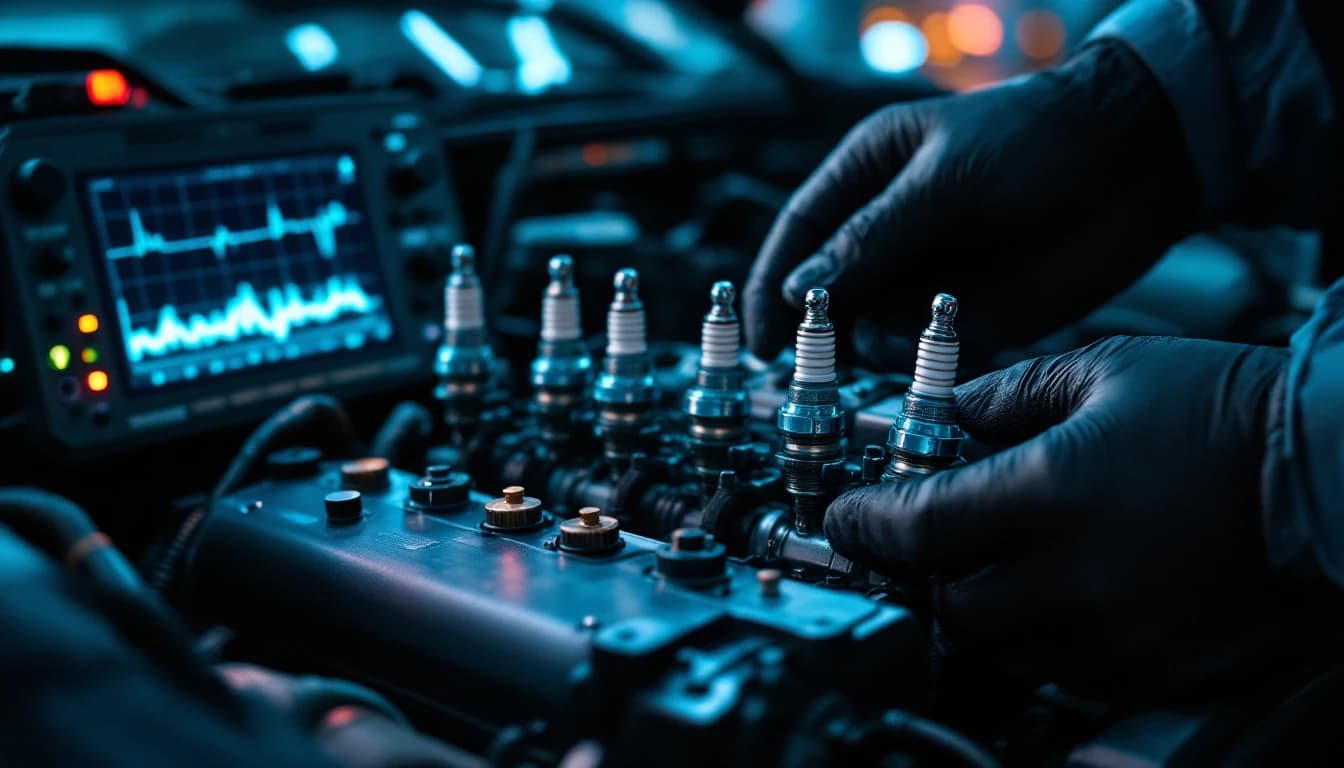
Multiple Cylinders Misfiring: Coil, Driver or ECM? (2026)
Why more than one cylinder misfiring is a different problem
If one cylinder misfires, you look at that cylinder: the coil, the plug, the injector, the compression. If two, three or four cylinders misfire at the same time, that approach wastes money, because the odds that independent parts failed together are small. What fails together is what is shared.
A modern engine shares a great deal between cylinders that looks separate on the parts diagram. Coils on many engines are fed from one fused power circuit. Injectors are fed from one supply and switched by driver circuits that are grouped inside the engine control module (ECM or PCM). Cylinders in one bank often share a ground point, a harness branch and a connector. And every cylinder depends on the same crankshaft and camshaft position signals to know when to fire.
So the practical rule is this: a multi-cylinder misfire is a pattern, and the pattern is the clue. Which cylinders? Always the same ones? Do they share a bank, a firing-order neighbour, a coil pack, an injector connector, a fuse? Answer those questions before you buy a single part.
This guide is written for the owner who has already seen a P0300-family code (random or multiple cylinder misfire) plus two or more specific cylinder codes such as P0301, P0302 and P0304, and wants to know whether the answer is cheap (a ground strap, a connector, a fuse) or expensive (a module). It is also written for independent shops deciding whether to ship a module for bench diagnosis.
As of November 2026, the module-side repair prices quoted here come from our live service pages. Everything else about shop labour, parts and dealer pricing is described in relative terms or labelled as a typical range, because those numbers vary widely by region and by vehicle. We do not quote a statistic we have not been able to verify.
What the misfire code actually tells you
Misfire detection is done by the ECM, which watches tiny changes in crankshaft speed as each cylinder fires. A cylinder that fails to contribute its share of torque shows up as a speed dip at the right point in the firing order, and the ECM stores a cylinder-specific code. The emissions regulators behind this monitoring, including the US EPA and the California Air Resources Board, require continuous misfire monitoring on modern vehicles because a sustained misfire can damage the catalytic converter and raises emissions sharply. The standards for the codes and the data you read through the diagnostic port are maintained through bodies such as SAE International.
What the code does not tell you is why the cylinder failed to fire. The ECM only sees the result. A cylinder with no spark, no fuel, low compression, a lost signal or an injector that never opened all produce the same speed dip. This is why the code is a starting point, and why two codes stored together are more useful than either alone.
Three patterns are worth noting before any testing:
- A random or multiple misfire code with no cylinder-specific codes (P0300 alone) points at something that affects the whole engine: fuel pressure, air metering, a vacuum leak, a crank signal problem or a power supply that dips under load.
- Two or more cylinder-specific codes that are firing-order neighbours or share a bank point at something shared by that group: a coil power feed, a ground, a connector, an injector driver group.
- Cylinder-specific codes that move when you swap parts point at the parts you swapped. Codes that stay on the same cylinders after a swap point at the wiring or the module side.
Ranked causes: from most to least likely
Experience on the bench and in the shop gives a consistent ranking. The most common shared-cause failures are cheap and easy; the module itself is last. We rank it last deliberately, because we would rather tell you to fix a ground than ship you a module you do not need.
1. Shared power or ground to the coils or injectors
Ignition coils and injectors need clean power and a clean return. If the shared feed (a fuse, a relay, a splice) or the shared ground point has high resistance, every device on it sees low voltage under load. The ECM sees weak or missing firing and sets codes on every affected cylinder. Typical culprits are a corroded engine ground strap, a loose battery or chassis ground, a coil power relay with burnt contacts and a connector with a spread terminal. This is the most common cause of simultaneous multi-cylinder misfire after an engine-bay repair or a wash, and it is the cheapest to fix.
2. Fuel or ignition supply problems that affect a group
Low fuel pressure from a weak pump, a clogged filter or a failing regulator often shows as a lean misfire on the cylinders furthest from the supply, or on all of them under load. On direct-injection engines the high-pressure pump adds another place to look. On the ignition side, a failed coil-driver supply or a shared ignition feed can drop several coils at once. These faults come and go with load, which is why the misfire is often worst under acceleration.
3. Crankshaft and camshaft position signals
If the ECM loses a clean crank or cam signal intermittently, it cannot time any cylinder reliably and the result is a random misfire across the engine, often with a stall or a hard restart. A tone-wheel with debris, a failing sensor, a damaged sensor connector or a sensor that only misbehaves hot all produce this. Look for crank and cam correlation codes and for a tachometer that flickers during the misfire.
4. Wiring, connectors and harness damage
Engine harnesses live in heat, vibration and oil. A chafed injector lead, a connector that has been unlatched and re-seated too many times, a rodent-chewed bundle, or oil wicking up a wire into a connector can take out a group of cylinders that share that branch. If the misfire changed after any work near the engine, suspect a connector that was not fully latched. Our guide to rodent damage versus module failure covers the harness side of this in detail.
5. A failed injector or coil that is loading the shared circuit
One shorted injector or one internally shorted coil can pull the shared supply down and take healthy neighbours with it. This is the subtle one: the part that is actually bad may not even be on a cylinder that is misfiring hardest. It is also why swap tests matter: moving one suspect part to another cylinder can show that the problem follows the part.
6. The injector or coil driver stage inside the ECM
Last on the list, but real. The ECM contains output stages, the driver circuits that switch each injector or coil. They carry real current, switch it thousands of times a minute and run hot. On some designs they are arranged in groups, so a driver failure takes out a fixed group of cylinders regardless of which injectors or coils are fitted. A failed stage can also be the consequence of an earlier shorted injector, which is why a car can need both an injector replaced and a module repaired. This is the only cause on the list that requires the module to come out of the vehicle.
The comparison: how each cause looks from the driver's seat
| Likely cause | Which cylinders | Follows swapped parts? | Typical clue | Where the fix is |
|---|---|---|---|---|
| Shared power or ground | A bank or a coil group | No | Worse under load, better after cleaning grounds | Fuse, relay, ground strap, connector |
| Fuel or ignition supply | Often all, worst under load | No | Pressure drop, lean trims, hard start | Pump, filter, regulator, coil supply |
| Crank or cam signal | Random, with stalls | No | Tachometer flicker, correlation codes | Sensor, tone wheel, sensor connector |
| Wiring or connector | A branch of the harness | No | Changed after nearby work, wiggle sensitive | Harness repair, connector service |
| Shorted injector or coil | One part, shared effects | Yes, the problem follows the part | Fault moves when part is swapped | Replace the part |
| Driver stage in the ECM | A fixed repeatable group | No, it stays on the same channels | Same cylinders every time, no wiring fault found | Board-level module repair |
The diagnostic order a shop actually uses
Order matters. The first steps are free or cheap and they rule out most causes. Skipping to the module is the most expensive way to be wrong.
Step 1: Read everything, then freeze it
Pull all codes, not only the misfire ones. Note which cylinders, whether the codes are current or history, and what the freeze-frame data says (engine speed, load, coolant temperature, fuel trims at the moment the fault set). A misfire that sets only at high load points at supply or ignition energy; one that sets cold points at injectors and mixture; one that sets only hot often points at a sensor or a driver stage. Our overview of how the control modules in a modern car fit together helps when other modules have stored codes too.
Step 2: Check the basics that mimic a module fault
Battery condition and charging voltage, grounds, fuses and relays for the ignition and injector circuits, fuel pressure against specification, and a visual check of the engine harness and connectors. A weak battery or alternator can make several coils and injectors misbehave together, and it can damage modules: see our notes on charging system faults that cause repeat module failure.
Step 3: Voltage-drop test the shared circuits
Measure the voltage drop across the power feed and across the ground path with the circuit loaded, not at rest. A ground that reads fine on an ohmmeter can drop a volt under real current. This is the single most valuable test for a multi-cylinder misfire and it is routinely skipped. The standards and tooling background for this kind of measurement are covered in resources from SAE International and in the service literature that manufacturers publish through their own sites.
Step 4: Swap tests
Move a coil or injector from a misfiring cylinder to a good cylinder, clear the codes and run the engine. If the misfire moves, the part is bad. If it stays on the same cylinder, the part is innocent and the cause is on the vehicle side or in the module. Swapping injectors on a direct-injection engine can require re-learning or coding on some platforms, so check the procedure for your car first.
Step 5: Look at the signals
A noid light on a port-injection injector connector, or an oscilloscope on the injector and coil circuits, shows whether the command is reaching the device and whether the current waveform looks right. A healthy command that is present at the connector with a bad waveform points at the harness or the part. A missing command on a fixed group of channels, with good power and ground, points at the module. Scope work is where a shop separates a wiring problem from a driver problem without guessing.
Step 6: Prove the module only when everything else is clear
If power, grounds, fuel, signals, wiring and parts have all been checked and the same cylinders still fail, the module is the remaining shared element. Before it comes out, record the module part number, the VIN, the cylinders affected and the evidence you have. That record also lets us tell you honestly whether bench repair is likely to work. Our guide on how to know which module failed before you ship it walks through the checklist.
A fixed group of dead cylinders that stays put after every coil, injector and ground has been proven good is the signature of a driver stage. A random misfire that wanders is almost never the module. Chasing the pattern saves more money than any single part does.
— Independent engine-management diagnostic technician, 18+ years in driveability and module diagnostics (anonymized)
The signs that point at the module, and the signs that do not
Points at the module:
- The same group of cylinders fails every time, and the group does not change when parts are swapped.
- Power, ground and sensor signals measure correctly at the module connector under load.
- The injector or coil command is missing, or the waveform is wrong, on a fixed set of channels even with known-good parts connected.
- Fault codes for output-stage or driver faults appear in the module itself, sometimes alongside the cylinder codes.
- A previous shorted injector or coil, or a jump-start or reversed-battery event, preceded the fault.
Does not point at the module:
- The misfire wanders between cylinders or changes from day to day.
- It started right after work near the harness, or after the engine bay was washed.
- Fuel pressure or battery voltage is out of specification.
- Swapping one part moved the misfire.
- The vehicle was running well until a single obvious event such as a connector being disturbed.
What it costs: the realistic ranges
Cost depends on which cause turns out to be true. The cheap causes are cheap; the module causes are not, but repairing the module you already own is usually well below buying a new one and programming it.
| Cause | Realistic cost, relative terms | Source of figure |
|---|---|---|
| Grounds, connectors, fuses, relays | Low, often a small shop labour charge | Typical shop labour, varies by region |
| Coils, plugs, a single injector | Low to moderate, a few parts and an hour or two of labour | Typical parts and labour, varies widely |
| Fuel pump or high-pressure pump | Moderate to high | Typical, varies by engine |
| Harness repair | Moderate, mostly labour | Typical, varies by damage |
| BMW MSD80 injector driver repair | $295 flat | Our live service page |
| Ford 6.7L Power Stroke PCM repair (2011-2016) | $395 flat | Our live service page |
| Duramax E35 ECM repair (2006-2007 LLY and LBZ) | $499.95 flat | Our live service page |
| New dealer module plus programming | High, quoted by the dealer | Dealer quote, varies by vehicle |
Those three prices are the services we list for module-level driver and ECM faults on the platforms named. If your vehicle is not on that list, text us your module part number and the symptoms: some modules are repairable and priced as a quote, and some are not. We tell you before you ship.
Return shipping is paid by the customer and chosen at checkout; it starts at $29.95 for standard shipping, with faster tiers available. A cart is one shipment, so one shipping charge covers every module in the box.
When the module is the answer: what bench repair involves
Board-level repair of a module that has lost an output stage is a mail-in job. The module is opened, inspected, powered on a bench harness that reproduces the vehicle connections, and tested under load. A failed driver stage, a damaged trace, a failed power component or a cracked solder joint can be repaired at component level. The repaired module is re-tested and returned. Typical turnaround on the bench is three to five business days from arrival.
The reason to repair your own module instead of replacing it is not only price. Your original module already holds your VIN, your calibration, your learned values and, on many vehicles, its security relationship with the rest of the car. A used or new module has none of that and must be programmed or matched before the engine will run. Our cost guide on duramax and power stroke ECM repair explains that trade-off for pickup diesels in detail, and the guide to repair versus replacement versus reprogramming covers it for other platforms.
What bench repair cannot do: it cannot fix a misfire whose true cause is a wire, a ground, a fuel problem or a mechanical fault. That is exactly why we tell people to finish the vehicle-side checks first. If the bench test shows that the module is healthy, we say so, and you have saved the cost of replacing a good module. Related reading on what is actually repairable at board level sets out the limits honestly.
How to prepare and ship a module
- Record the vehicle year, make, model, engine and VIN.
- Write down the cylinders affected, whether it is repeatable, and which codes are current.
- Photograph the module label (part and serial numbers) before removal.
- Disconnect the battery before removing the module, and handle it by the case, not the connector pins.
- Pack it in an anti-static bag inside a rigid box with padding, and include a note with your name, the order number and the symptoms.
- Proof of ownership is required for any key, immobilizer or security-related work, and we may ask for the VIN to match the module.
Our walkthrough on how to remove, package and ship a car module has the full packing detail, and static damage is covered in the guide to ESD and module handling.
Common mistakes that waste money
- Replacing all the coils or all the injectors. If the cause is shared, new parts will fail the same way.
- Clearing codes and driving. A sustained misfire can damage the catalytic converter, which is a far more expensive repair than the original fault.
- Testing grounds at rest. A ground that looks fine without current can fail under load.
- Swapping the module for a used one. A used module is the same age as yours, and it may need programming to your VIN before it runs.
- Ignoring a recent event. A jump-start, a battery reversal, a wash or a connector disturbed during other work is often the real trigger. Our guide on jump-start and overvoltage module damage explains the failure path.
For vehicle-safety background, including how emissions and drivability faults interact with safety-related systems, the National Highway Traffic Safety Administration publishes owner resources, and independent testing context can be found at the Insurance Institute for Highway Safety. For general repair-market coverage and model-specific reliability reporting, outlets such as Car and Driver and MotorTrend are useful starting points.
Frequently asked questions
Can one bad part cause several cylinders to misfire at the same time?
Yes, when the part is shared. A weak power feed, a poor ground, a failing crank sensor or a failed output driver group inside the engine computer can each affect several cylinders at once. A single shorted coil or injector can also pull a shared circuit down and disturb its neighbours, so the cylinder that misfires hardest is not always the one with the bad part.
How do I tell a bad coil from a bad injector driver in the ECM?
Swap the suspect coil to a different cylinder and see whether the misfire moves. If it follows the coil, the coil is bad. If it stays on the same cylinder, and the same fixed group of cylinders keeps failing after parts, power, ground and wiring are all proven good, the driver stage in the computer becomes the leading suspect. A scope or noid light on the connector confirms whether the command is arriving.
Is it safe to keep driving with multiple cylinders misfiring?
It is not advisable. A sustained misfire pushes unburned fuel into the exhaust, which can overheat and damage the catalytic converter, and a flashing check engine light is the vehicle warning you of that risk. Reduce load, avoid towing and hard acceleration, and have it diagnosed promptly rather than driving it for weeks.
Will clearing the codes fix a multi-cylinder misfire?
No. Clearing codes only removes the stored fault and resets monitors; the cause remains and the codes will return as soon as the fault is detected again. It can also hide freeze-frame data that a technician needs, so read and record everything before you clear anything.
Can you repair my engine computer if the injector or coil drivers have failed?
For the platforms we list, yes: BMW MSD80 injector driver repair is $295, the Ford 6.7L Power Stroke PCM repair is $395 and the Duramax E35 ECM repair is $499.95, each as a flat repair of your own module. For other modules, text us the part number and symptoms and we will tell you whether bench repair is realistic before you ship anything.
Is repairing the module cheaper than replacing it?
Usually, because a replacement module generally has to be programmed or matched to your vehicle before it runs, while your own repaired module already carries your VIN and calibration. Dealer and parts prices vary by vehicle and region, so compare an actual quote for your car against the flat repair price, plus return shipping from $29.95.
How long does a mail-in module repair take?
Typical bench turnaround is three to five business days once the module reaches us, plus transit each way. Return shipping is paid by you and chosen at checkout; faster tiers are available if you are without the vehicle.
The bottom line
A misfire on several cylinders at once is a pattern, and the pattern points at what those cylinders share. Start with the cheap, common causes: power, ground, fuses, relays, connectors, fuel supply and crank and cam signals. Use swap tests and voltage-drop measurements to prove them, and read freeze-frame data before you clear anything. Only when the same fixed group of cylinders keeps failing with every outside cause ruled out does the engine computer become the answer, and then repairing your own module is usually the cheaper and cleaner route than replacing it.
If you have reached that point, text us your vehicle, the module part number and the cylinders affected. We will tell you honestly whether bench repair is likely to work, and we will not ask you to ship anything until it makes sense. Ship-to details are given with your order, and return shipping is chosen at checkout, from $29.95.
Ship it for the bmw msd80 injector driver repair — $295 flat
Typical 3-5 Business Day Bench Turnaround, return speed your choice at checkout. Prepaid inbound label by email the minute you order.
More from the Lab
Heavy-Duty Truck ECM Repair Cost — Mail-In Service (2026)
12 min · November 2, 2026
Duramax & Power Stroke ECM Repair Cost (2026)
13 min · September 11, 2026

Mail-In Module Service: Total Cost With Shipping (2026)
11 min · November 2, 2026
Scan Tool Won't Connect to the ECU? What to Check (2026)
16 min · November 2, 2026